
Poshness Is a Culture Too
In modern Britain, every culture is expected to be respected and preserved - except the English upper-classes.


There is something oddly revealing about the modern British attitude to class. We are endlessly told that every culture must be protected, celebrated and treated with sensitivity. A Welsh student who returned from university speaking with a clipped Home Counties accent would be pitied as someone alienated from his roots, pressured into abandoning his identity in order to fit in with an elite. It's the sort of thing that would cause anguished articles about cultural suppression, internalised shame and the tragedy of losing touch with one's community. And quite right too.
Yet there is one culture in Britain for which none of this sympathy applies. One culture it remains not merely acceptable but positively fashionable to sneer at: the English upper classes. A poor country squire spends a fortune on top boarding schools, only to find that after six months at uni, the prodigal son returns home sounding in equal parts like a gangsta rapper and a Hackney cab driver. There is nothing wrong with Hackney cab drivers - on the contrary, I hold them in great esteem. I'm less certain about gangsta rappers - but we're drifting.
The sad point is that as a young posho today, society has made it very clear that your culture is nothing to be proud of. It is, in fact, something to hide away outside a small circle of friends from your school days. Society makes it very clear that the upper classes should be taught to feel embarrassed by their own background.
No other group is expected to perform this ritual self-erasure. We would rightly recoil at comedians blacking up their faces or putting on exaggerated Indian or Caribbean accents for laughs. Entire careers are destroyed over such behaviour. But put on a pair of red trousers and speak the way English is actually supposed to sound, and everyone finds it hilarious. The posh Englishman has become the last permissible object of open ridicule in British life.
More than that, parts of the British establishment now seem actively hostile towards the traditions historically associated with our culture. Fox hunting is not merely opposed on animal welfare grounds, but denounced as something shameful and socially illegitimate. Shooting parties are portrayed as faintly sinister. Country pursuits, old institutions, inherited manners and even accents themselves are all quietly nudged towards extinction by a cultural elite that insists it is opposed to cultural suppression. We are instructed to treat every custom, every dialect and every inherited identity as precious and untouchable - except the English upper-class one. That alone may be mocked, dismantled and driven out.
The truth is that poshness is a culture. It has its own codes, manners, humour, traditions, vocabulary and social rituals built over centuries. One may like it or dislike it, just as one may admire or criticise any other culture. But the idea that it alone deserves no respect at all is not tolerance. It is simply prejudice in different clothes.
Also by Charles H. Thyme
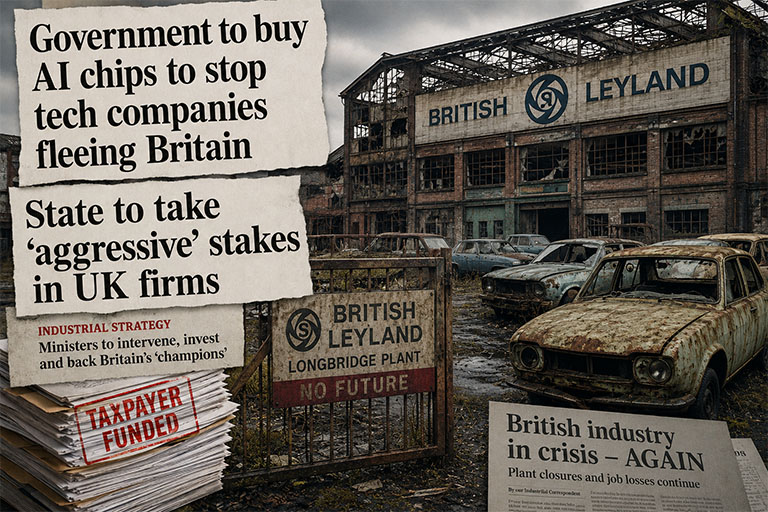
Back to the Future IV: Return of British Leyland
Faced with falling investment and an increasingly hostile business climate, Labour has reached for the only solution it truly understands: more state, more intervention and more bureaucracy. We have seen this experiment before. It failed then, and it will fail again.

Why the Left Hates Independent Education
The attack on private education is often presented as a crusade for equality. In reality, it is something quite different. Independent schools challenge some of the Left's deepest assumptions about society, proving that parental choice, competition and individual aspiration can outperform state control. That is why the campaign against them persists despite the costs, the consequences and the evidence. The target is not what independent schools do. The target is what they represent.

We Are All Born Capitalists
Capitalism is often portrayed as a modern invention imposed upon society by financiers and corporations. In reality, it is simply the natural extension of ordinary human behaviour: specialisation, cooperation and voluntary exchange. From a Neolithic tribesman trading a stone axe for two fish to the complex global markets of today, free exchange has always allowed individuals to coordinate knowledge, allocate resources and improve living standards more effectively than central planning ever could.