
We Are All Born Capitalists
Long before economists, corporations or governments existed, voluntary exchange and market signals were already driving human prosperity.

Capitalism is not an artificial invention imposed upon humanity by modern economists or billionaires. It is, in fact, the natural extension of ordinary human behaviour. Long before stock markets, banks or multinational corporations existed, human beings were already engaging in the same principles that underpin capitalism. Capitalism is the default mode of human economic interaction.
Imagine a Neolithic tribesman who has become particularly skilled at shaping stone axes. After making enough for his own needs, he has an extra axe available. Meanwhile, a fisherman nearby has enjoyed an excellent catch but lacks a reliable cutting tool. The two meet and agree to exchange the axe for two fish.
That simple exchange contains the essence of capitalism.
The axe-maker does not need to spend years learning how to fish. The fisherman does not need to spend countless hours learning how to shape flint. Each specialises in what he does best. Each benefits from the effort, skill and knowledge of the other. Both leave the exchange wealthier than before.
Most importantly, the value of the trade is decided voluntarily between them. Neither is forced. Neither is coerced. Together, both conclude that one axe is worth two fish. That is capitalism in its most basic form: voluntary exchange for mutual benefit.
Notice what did not happen. The chief of the tribe did not summon everyone together and declare that henceforth all axes would be valued at exactly two fish. No tribal planning committee spent months calculating "fair" fish-to-axe ratios. No bureaucrat attempted to estimate future axe production quotas.
Had they done so, the tribe would quickly face the same problems as every centrally planned economy. Sometimes there would be too many axes and not enough fish; other times surplus fish would rot because too many had been caught while too few tools were produced. People would inevitably begin gaming the system. Toolmakers would produce smaller and smaller axes while fishermen caught smaller and smaller fish.
History is full of examples of this failure. Soviet factories ordered to produce chandeliers by weight produced grotesquely heavy chandeliers. Nail factories given targets based on quantity produced millions of tiny useless nails; when targets switched to weight, they produced a handful of gigantic unusable ones. Ordinary people received inferior products because the system had lost the only truly accurate measurement of value: supply and demand.
Capitalism solves this problem naturally because prices are not merely arbitrary numbers attached to objects. They are signals. They communicate information more efficiently than any bureaucracy ever could.
Economists from Ludwig von Mises to Friedrich Hayek argued that centrally planned systems fail because no planning authority can ever gather or process enough information quickly enough to allocate resources efficiently. But the fisherman knows the rivers; the axe-maker knows the stone; the farmer understands the soil and the weather. Millions of individuals each hold small pieces of knowledge unavailable to distant planners. Capitalism alone allows these countless decisions to coordinate organically.
This is why free economies are adaptive while centrally planned economies are rigid and brittle. When conditions change, markets react immediately. If demand for a product rises, higher prices encourage greater production. If a resource becomes scarce, people naturally conserve it or seek alternatives. The market constantly adjusts itself.
Critics often portray capitalism as cold or selfish, yet voluntary exchange is fundamentally cooperative. Every transaction requires both parties to believe they are benefiting. The baker provides bread because customers want bread. The customer pays because he values the bread more than the money. Both sides gain. Wealth is created precisely because exchange allows resources to move towards their most valued use.
Sadly, modern governments increasingly interfere with this natural process. Excessive bureaucracy, overregulation, price controls and endless state intervention distort the market and prevent it from functioning efficiently. If demand for homes rises but construction is strangled by planning restrictions, slow approvals and regulatory burdens, prices inevitably spiral upwards. Politicians then blame "market failure".
Blaming market failure is often a precursor to imposing rent controls or other artificial fixes, which merely worsen shortages further. Trying to suppress prices without addressing the underlying lack of supply is like forcing the lid down on a boiling kettle. Pressure continues building underneath. The real problem in the housing market is lack of supply. Price controls do not fix that.
The real problem is not capitalism, but the obstruction of capitalism.
Too often, the public is told that the suffering caused by distorted or overregulated markets somehow represents the failure of free markets themselves. Usually, these crises emerge precisely because the market is prevented from responding naturally to changing conditions.
Capitalism is not perfect because human beings are not perfect. But it remains the only economic system that recognises how humans actually behave rather than how political theorists wish they behaved. It harnesses self-interest, rewards innovation, encourages cooperation and distributes information more efficiently than any central authority ever could.
When politicians break the market, blame the politicians — not capitalism.
Also by Charles H. Thyme
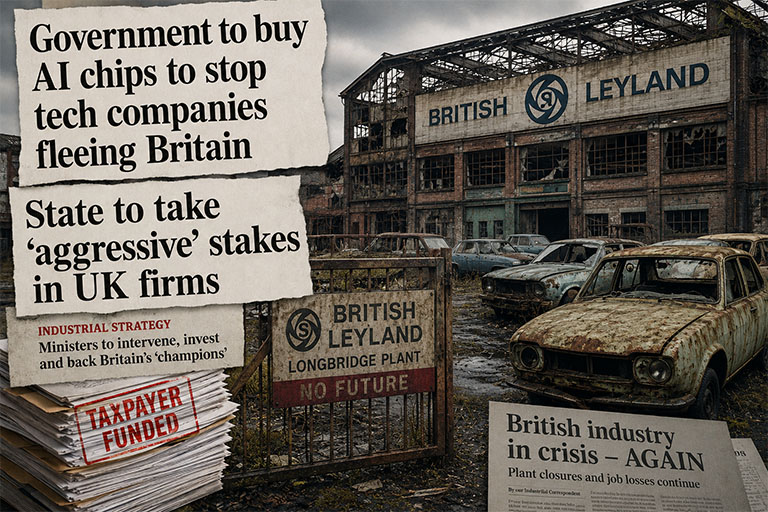
Back to the Future IV: Return of British Leyland
Faced with falling investment and an increasingly hostile business climate, Labour has reached for the only solution it truly understands: more state, more intervention and more bureaucracy. We have seen this experiment before. It failed then, and it will fail again.
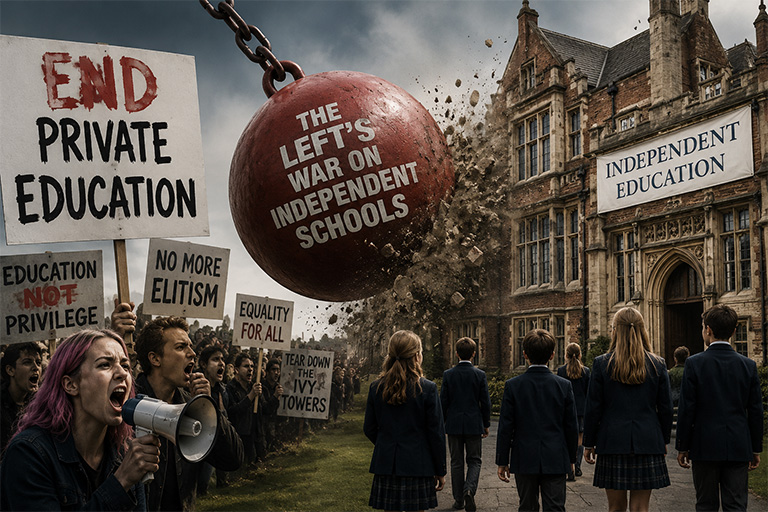
Why the Left Hates Independent Education
The attack on private education is often presented as a crusade for equality. In reality, it is something quite different. Independent schools challenge some of the Left's deepest assumptions about society, proving that parental choice, competition and individual aspiration can outperform state control. That is why the campaign against them persists despite the costs, the consequences and the evidence. The target is not what independent schools do. The target is what they represent.

Politics as Religion: Why the Modern Left Cannot Tolerate Dissent
Why does political disagreement increasingly provoke outrage rather than argument? Because for many modern progressives, politics is no longer simply about economics or governance - it has become a moral identity, complete with saints, heretics and sacred institutions. And history suggests that societies rarely emerge peacefully once politics takes on the character of religion.