
Abolishing Private Schools Will Hurt the Weakest in Society
The Left believes abolishing private schools will create equality. They are wrong. The winners would stay the same. Only the bill would change.
One of the most noticeable policies of the born again hard Left is their attacks on private education. We are told this is a blow against privilege. Remove Eton, Harrow and Wycombe Abbey, we are told, and Britain will finally become a fairer society.
Yet, the uncomfortable reality is that if private schools disappeared tomorrow, the children who succeed would be almost exactly the same children who succeed today. The institutions would change, the winners would not.
The first reason is simple: Britain's greatest educational inequality is not between the private and state sectors. It is within the state sector itself.
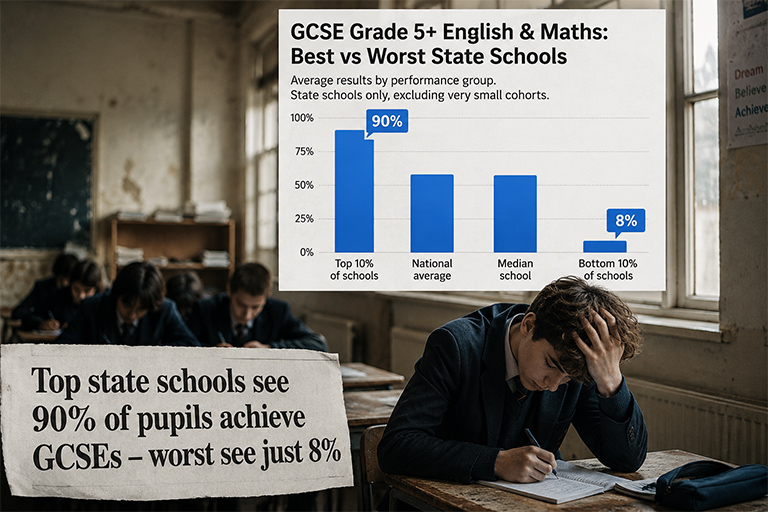
The best state schools achieve results that rival or exceed many independent schools. The worst perform dramatically worse than the national average. Depending on the measure used, pupils at the strongest state schools can be more than ten times as likely to achieve key academic benchmarks as pupils at the weakest. According to figures published by DfE, the best tenth of state schools achieve a 90% KS4 pass rate; the worst tenth achieve just 8%.
So where would the children currently attending private schools end up? Would they suddenly find themselves attending the weakest-performing schools in the country?
Of course not. Their parents would do exactly what ambitious parents have always done. They would compete for places at the best schools available. They would move house. They would navigate admissions systems. They would use tutors. They would prepare for grammar school entrance examinations. They would ensure their children attended the highest-performing schools they could possibly access.
In practice, many of the children currently attending private schools would simply displace some of the pupils who currently occupy those places.
The second flaw in the anti-private-school argument is that it underestimates the determination of those parents now willing to nearly bankrupt themselves for a private school place. This is not about merely purchasing a service - it's a signal of priorities.
These are parents who read to their children from an early age. They monitor homework. They attend parents' evenings. They arrange music lessons. They pay for sports coaching. They enrol their children in summer programmes. They encourage academic ambition and expect educational success.
Take away the private school and those behaviours do not disappear. The children still go home to the same parents. The books are still on the shelves. The tutors still arrive on Tuesday evening. The violin lessons still take place on Saturday morning.
The educational advantage remains.
This is the uncomfortable truth that many campaigners would rather ignore: schools matter, but families matter more. Educational outcomes are heavily influenced by what happens outside the classroom. Banning private schools does nothing to equalise parental engagement.
Nor would abolishing private schools destroy elite networks. The old-school-tie network will survive. If every independent school closed tomorrow, ambitious families would simply create new pathways to elite institutions through the best state schools, the best universities and the most prestigious professions.
There is a strong possibility that banning private schools would make certain inequalities worse. Today, parents who want additional educational advantages generally pay for them themselves. If private schools disappeared, the demand for elite education would not disappear with them. Instead, that demand would be redirected into the state sector.
Competition for the best state schools would intensify. House prices around desirable catchment areas would rise even further. Political pressure would grow to expand places at already successful schools. The most influential and well-connected parents in the country would focus their efforts on securing advantages within the state system. We're already seeing this happening thanks to the recent attacks on independent schools.
The winners will be the same affluent, educated and highly engaged families who succeed under the current system.
The absurd difference is that they would no longer be paying for their privilege. Instead, they would be competing for resources funded by the taxpayer. At the cost of the weakest children.
The biggest tragedy is that this debate distracts from the real educational scandal. The most urgent problem in British education is not that some children attend Eton. It is the huge gap between the best and worst state schools.
Closing that gap will transform thousands of lives. Closing private schools will not.
Also by Julian March

The Great British Pyramid Scheme
Britain has built far more than a housing market. It has built an entire economic model upon ever-rising property values. As house prices soared, politicians congratulated themselves on “growth”, homeowners refinanced, banks expanded lending and the country consumed against paper wealth. But property prices cannot indefinitely outgrow purchasing power. Now, with transactions slowing and affordability breaking down, Britain is beginning to discover what happens when an economy built on asset inflation starts running out of road.

Andy Burnham Is Not the Answer
Andy Burnham has become the acceptable face of Labour populism: media-friendly, emotionally fluent and packaged as a champion of the North. But beneath the carefully constructed image lies a familiar political instinct — more state control, more public spending and more bureaucracy. Britain does not need another eloquent manager of decline. It needs a fundamental change of direction.
The Empire: Ashamed of Our Greatest Achievement
Modern Britain has developed an almost neurotic inability to discuss the British Empire honestly. We are encouraged to remember only the sins and never the achievements. Yet judged against the age in which it existed, the Empire abolished slavery on a global scale, spread parliamentary institutions and left behind legal and political systems still relied upon across much of the world today.