
Why the Left Hates Independent Education
To the modern Left, independent schools are not educational institutions but symbols of everything they despise: ambition, excellence, independence and success.

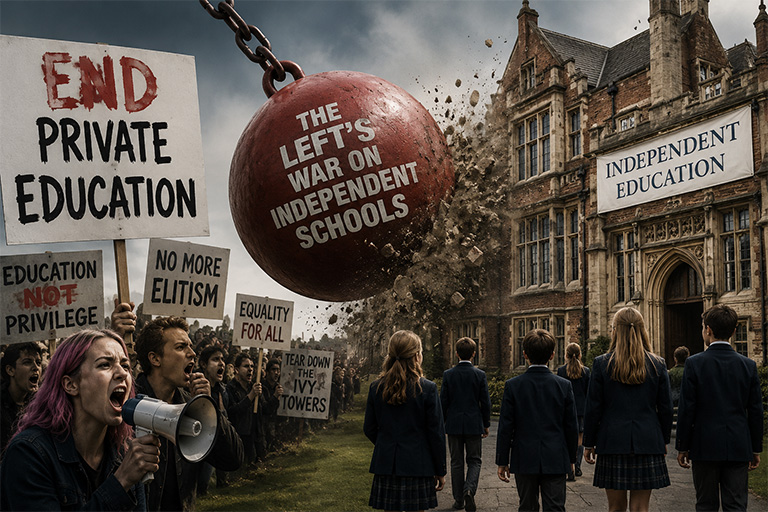
The Left's obsession with destroying independent education has never really been about schools.
It has never been about improving standards. It has never been about helping disadvantaged children. It has never even been about education. It is about ideology.
If one wants to understand why private schools provoke such hostility on the Left, one must first understand how the modern Left views society. To the socialist mind, education is not merely a public good. It is a mechanism through which society is shaped. It is where values are transmitted, language is defined, attitudes are formed and future voters are moulded.
The state school system therefore occupies a special place in left-wing thinking. It is not simply a provider of education. It is an instrument of social engineering.
Independent schools represent an alternative. They are institutions beyond direct state control. They allow parents to exercise choice. They create competing educational philosophies. Most importantly, they remind people that the state does not have a monopoly on educating children.
That alone makes them suspect.
But the hostility runs deeper than that. Private schools are often chosen by precisely the sort of people the Left distrusts most: ambitious parents determined to improve their children's prospects. These are families unwilling to accept whatever educational provision the state happens to assign them. They are willing to make sacrifices, work harder, save money and take responsibility for their own children's future. And few things irritate the modern Left more than individual ambition.
For all the rhetoric about opportunity, much of left-wing politics today is deeply uncomfortable with excellence. Success is viewed with suspicion. Achievement is often treated as evidence of privilege.
This too explains why independent schools attract such hostility. They produce high achievers; they produce ambitious children. They create environments where academic excellence is celebrated. They demonstrate that some children will perform better than others when given the opportunity to flourish. And in the end, empirically, they create success.
That presents a fundamental problem for an ideology obsessed with equality of outcome. The uncomfortable truth is that people are different. They possess different talents, different levels of motivation, different interests and different abilities. Even under conditions of perfect fairness, outcomes will always remain unequal.
Independent schools demonstrate this reality. The Left therefore finds itself trapped. If excellence is allowed to flourish openly, it exposes the futility of endless equality measures. The existence of exceptionally successful students serves as a constant reminder that human beings are not interchangeable units in a government spreadsheet.
And on top of all that, there is the question of competence. Perhaps the greatest threat independent schools pose to socialist thinking is that they prove the state is not automatically best at running things.
For decades, the Left has argued that public ownership, public management and state provision represent the superior way of organising society. Yet independent schools stand as a visible, everyday challenge to that belief. Parents can compare outcomes. They can compare facilities. They can compare discipline, culture, academic performance and university admissions. And to the Left, that comparison is an embarrassment.
Independent schools are living evidence that competition, choice and independence can produce better results than bureaucracy.
Independent schools save the taxpayer vast sums by educating hundreds of thousands of children without requiring state funding. They employ tens of thousands of people. They generate significant economic activity. Many specialise in supporting children with special educational needs. Many offer bursaries that transform lives.
None of this matters to the Left. The target is not the reality of independent education. The target is what independent education symbolises.
To the Left, private schools represent Eton. They represent grand buildings, traditions, achievement, confidence, success and privilege.
The average independent school bears little resemblance to the caricature presented by its opponents. Many are small schools serving ordinary middle-class families. Many specialise in SEND provision. Some struggle financially. Yet none of that matters. The Left does not oppose independent schools as they are. It opposes independent schools as they exist in the socialist imagination: Eton, privilege, inherited wealth and social hierarchy. The symbol is more important than the reality.
And therefore, the destruction of private education becomes an objective in itself. One revealing comparison is the attitude of New Labour in the 1990s and early 2000s. Whatever one thinks of Tony Blair and his government, they were fundamentally pragmatists. They understood that independent schools relieved pressure on the state sector. They recognised that destroying a successful industry would be economically irrational.
To New Labour, the destruction of independent education was illogical. But then, New Labour wanted power. The modern Left wants purity. Viewed through that lens, their attacks on independent education suddenly make perfect sense.
It may be financially illiterate; it may increase pressure on state schools. It may make schools worse for everyone. But the objective is not efficiency or logic. It is destruction.
Independent schools simply embody too many things the Left dislikes: parental choice, individual responsibility, competition, excellence, ambition, independence and the inconvenient fact that the state is not always the best solution.
They must be destroyed, not because they have failed, but because they have succeeded.
Also by Charles H. Thyme
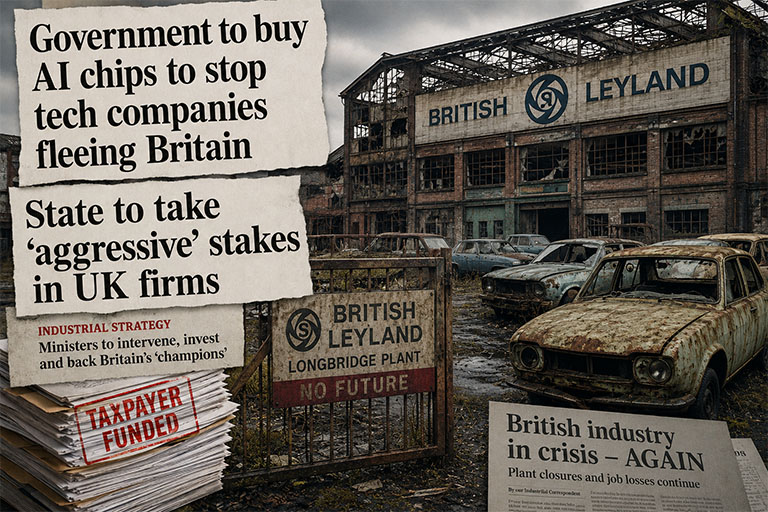
Back to the Future IV: Return of British Leyland
Faced with falling investment and an increasingly hostile business climate, Labour has reached for the only solution it truly understands: more state, more intervention and more bureaucracy. We have seen this experiment before. It failed then, and it will fail again.

We Are All Born Capitalists
Capitalism is often portrayed as a modern invention imposed upon society by financiers and corporations. In reality, it is simply the natural extension of ordinary human behaviour: specialisation, cooperation and voluntary exchange. From a Neolithic tribesman trading a stone axe for two fish to the complex global markets of today, free exchange has always allowed individuals to coordinate knowledge, allocate resources and improve living standards more effectively than central planning ever could.

Politics as Religion: Why the Modern Left Cannot Tolerate Dissent
Why does political disagreement increasingly provoke outrage rather than argument? Because for many modern progressives, politics is no longer simply about economics or governance - it has become a moral identity, complete with saints, heretics and sacred institutions. And history suggests that societies rarely emerge peacefully once politics takes on the character of religion.