
Labour Thinks Markets Should Obey Politicians
Paula Barker’s astonishing remarks expose a deeper problem inside modern Labour: a generation of politicians who barely understand how markets work.

Earlier this week I called "socialism the most childish of all the -isms". You can agree or disagree, but when it comes to the British Labour Party it is hard not to describe them as economically infantile.
Labour MP Paula Barker did nothing to change this impression when she claimed that bond markets should simply "fall into line" with an Andy Burnham government. In fact, her comments made it painfully clear that we are governed by people whose formative years were spent role-playing as student activists, safely insulated from the real world and the consequences of their own absurd policies.
Bond markets are not an arm of the Labour Party. They are not there to applaud "progressive policies" or nod along to conference speeches. They are global investors deciding whether Britain looks like a good investment or not.
When governments lose credibility, markets react. Borrowing costs rise. End result? The pound weakens; mortgages become more expensive. That is not ideology. It is how modern finance works.
One might have thought Britain had learned this lesson with Liz Truss. She approached the markets with the same mixture of arrogance and economic illiteracy, simply from the opposite direction politically. Her government behaved as though confidence could be created by force of will and ideological certainty. The core attitude was the same, however: politicians believed they were in charge, not the bond markets. Within weeks, the gilt market was in chaos and the Bank of England was forced to step in.
Yet Labour now risks making exactly the same mistake. The rhetoric is different, but the mindset is similar: a belief that markets should obediently cough up money for whatever politicians decide to spend.
Is this anti-democratic? No. A government can do whatever it wants. It could make disability a legal tender and tax IQ. But after they cock up and have to come cap-in-hand to borrow from private entities to finance their ever worsening budget deficits, they become subject to market law.
There is already an idiot premium on British gilts and we're all paying for it. The government is running close to a £150 billion deficit and that can either be funded by printing money - which makes our money worth less - or it can be financed through borrowing. The more irresponsible you look, the more expensive borrowing becomes. And Labour MPs like Paula Barker are not helping.
It is worth remembering that in the end it is the British taxpayer that is paying for all this. As Milton Friedman once pointed out: if you want to know what the true tax is, look at total government spending. And since COVID government spending in the UK is completely out of control. We were already heading downhill, but Labour has decided to step hard on the accelerator.
At some point even socialist policies meet with reality. In fact that is how every socialist government ends. If you jump off a cliff, it doesn't hurt until you hit the ground. Socialism is about pretending everything is OK on the way down; capitalism is about avoiding the cliff in the first place.
The big political shift in Britain is that there are no longer any real capitalist parties on the ballot. From Labour to Reform, every party has decided that we have probably jumped off the cliff already and all we can do is pretend everything is fine on the way down.
The only thing that sets Labour apart is the sheer confidence with which some Labour politicians display their ignorance. They speak as though fiscal caution is merely a political choice rather than an economic necessity. The markets will not overlook borrowing problems simply because the government claims its intentions are compassionate.
Markets do not work like that. Pension funds in Singapore and bond traders in New York are not sitting around waiting to be inspired by speeches about "our communities". They want to know whether Britain looks financially stable. Labour is simply hastening the eventual crash-landing.
Also by Charles H. Thyme
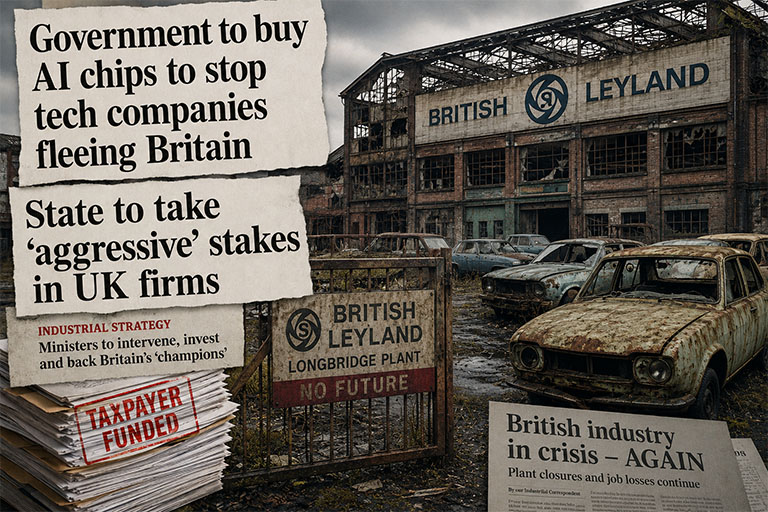
Back to the Future IV: Return of British Leyland
Faced with falling investment and an increasingly hostile business climate, Labour has reached for the only solution it truly understands: more state, more intervention and more bureaucracy. We have seen this experiment before. It failed then, and it will fail again.

Why the Left Hates Independent Education
The attack on private education is often presented as a crusade for equality. In reality, it is something quite different. Independent schools challenge some of the Left's deepest assumptions about society, proving that parental choice, competition and individual aspiration can outperform state control. That is why the campaign against them persists despite the costs, the consequences and the evidence. The target is not what independent schools do. The target is what they represent.

We Are All Born Capitalists
Capitalism is often portrayed as a modern invention imposed upon society by financiers and corporations. In reality, it is simply the natural extension of ordinary human behaviour: specialisation, cooperation and voluntary exchange. From a Neolithic tribesman trading a stone axe for two fish to the complex global markets of today, free exchange has always allowed individuals to coordinate knowledge, allocate resources and improve living standards more effectively than central planning ever could.