
The Great British Pyramid Scheme
For two decades, rising house prices have masked economic stagnation, inflated a dangerous national dependency on debt and asset inflation, and quietly transformed Britain into a leveraged property trade masquerading as a productive economy.


It is a truth universally acknowledged that house prices must always rise.
Not should rise. Must rise.
For decades, Britain — like many Western countries — has organised much of its economy around this assumption. Governments depended on it. Banks depended on it. Ordinary homeowners depended on it. According to research from Savills, the total value of UK residential housing stock now stands at a mind-blowing £10 trillion. In comparison, UK households hold about £1.5 trillion in savings.
At that scale, small changes represent enormous changes in the country's total wealth. Just a few years of house price growth can easily exceed the total savings of every household in Britain combined. A 15 per cent rise in property values represents wealth equivalent to roughly half of annual GDP.
Who needs coal mines, factories or industry operating on razor-thin margins when rising house prices can create the illusion of prosperity overnight? Over the last twenty years, UK GDP has grown by £1.5 trillion. During the same period, the value of the UK residential property market has grown by roughly £6 trillion. Economists generally estimate that a £1 increase in housing wealth generates roughly 8p of economic activity through the housing wealth effect.
Suddenly, property inflation starts looking less like a side story and more like one of the central engines of Britain's post-2000 economy.
Add to this that Britain is not a nation of investors. We are a nation of homeowners. Entire generations have structured their retirements around ever-rising property values. The country has not merely had a housing market; it has built an economic model upon residential asset inflation.
Which is why the latest signs of paralysis in the housing market ought to alarm not just policymakers but us all.
It now takes almost seven months to sell a property in Britain. Transactions are slowing; deals are increasingly collapsing late in the process. Many homeowners are beginning to discover that paper wealth is not the same thing as actual money.
Most worrying of all, the market is not slowing because people no longer want homes. It is slowing because the arithmetic is finally beginning to fail.
For years, Britain has behaved less like a productive economy and more like a giant leveraged property trade. Rising house prices created the appearance of prosperity. Homeowners felt wealthier, refinanced their homes, extracted equity and spent the proceeds into the wider economy. Governments enjoyed higher tax revenues. Banks expanded mortgage lending. Politicians congratulated themselves on economic "growth".
But much of it was never genuine growth at all.
Strip away the property effect and large parts of Britain's economic performance over the past two decades begin to look not weak, but catastrophic. Productivity growth has stagnated. Manufacturing has steadily diminished. Industrial capacity has evaporated. Across large parts of the country, the old productive economy has been replaced not with advanced industry, but with a service economy increasingly geared towards consumption rather than production.
The modern British high street often feels less like the commercial centre of a serious industrial nation and more like somewhere to hang about while you wait for your property to appreciate: coffee shops, nail salons, barbers and estate agents servicing a population whose primary source of perceived wealth is the rising value of its homes.
Housing supply does matter, of course. Britain has failed to build enough homes for decades. But for something as mass-market as residential property, demand-side financing ultimately matters more. Prices cannot indefinitely outgrow purchasing power.
The average UK house now costs roughly nine times average annual earnings — and that figure is based on gross pre-tax income. On a net disposable income basis, the ratios are even more extreme. Crucially, lenders do not generally lend eight to ten times salary.
At some point, the market simply runs out of people capable of financing the next leg upwards.
Politicians have nevertheless done everything possible to keep the system functioning, partly because many understand perfectly well what happens if property inflation stops. Hence the increasingly desperate balancing acts: subsidising demand while promising affordability; restricting development while lamenting shortages; protecting existing homeowners while claiming to champion first-time buyers.
For years, virtually every structural force has favoured higher prices. Supply has been constrained through planning restrictions and bureaucratic inertia. Interest rates were held at historically abnormal lows for more than a decade. Population growth through immigration increased housing demand still further.
Quite frankly, Britain has spent years doing almost everything imaginable to inflate property values because deep down much of the political class understood that house price growth had become the country's primary economic engine.
But the market is rapidly running out of road.
Britain is unlikely to see another prolonged era of dramatic real house price growth. The best-case scenario may now be stagnation. Yet stagnation can be almost as politically dangerous as collapse.
A housing market that no longer rises relentlessly creates profound problems for Britain's economic model. Consumers feel poorer. Refinancing slows. Spending weakens. Stamp duty revenues fall. Construction softens. Pension assumptions begin to look fragile. The "wealth effect" that quietly sustained large parts of the economy begins to evaporate.
Britain increasingly resembles a country trapped between two impossible positions. House prices are too high for young people to buy comfortably, but too important to the financial system to be allowed to fall substantially.
The result is a system that satisfies almost nobody. Young professionals devote enormous portions of their income to housing costs. Families delay having children because they cannot afford sufficient space. Economic mobility weakens because people cannot easily relocate for work.
The practical solution is obvious: build more homes.
But therein lies the political trap. Build enough homes to restore affordability and you undermine the asset inflation upon which so much of the wider economy now depends.
None of this resembles a healthy economy. Nor does it resemble a healthy society.
There was always another path available. Britain could have pursued genuine productive growth: investment, industry, energy, infrastructure, technological development and rising real wages. We could have allowed prosperity to come from producing more rather than merely revaluing existing assets.
Inflating house prices required little more than cheap credit and tweaks to stamp duty — genuine economic growth required political courage and difficult reforms.
And no one would accuse our political class of being courageous.
Also by Julian March
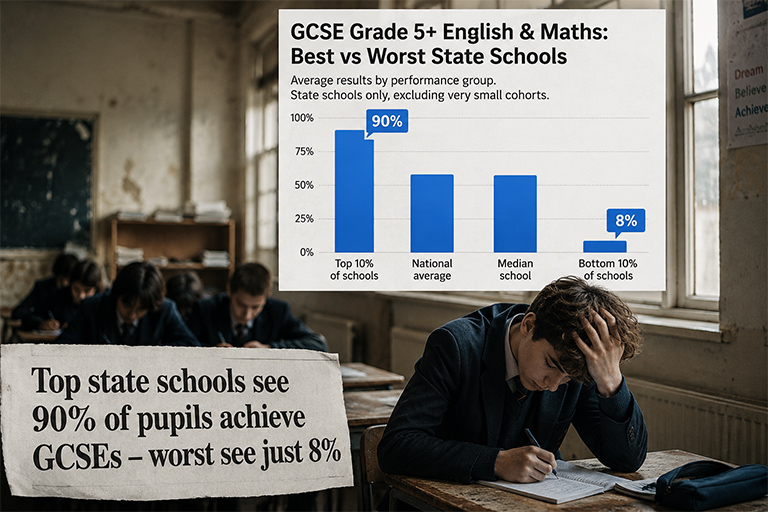
Abolishing Private Schools Will Hurt the Weakest in Society
Britain's greatest educational divide is not between private and state schools, but between the best and worst state schools. Abolishing independent education would not change who succeeds. It would simply redirect affluent, ambitious and well-connected parents into the state sector, leaving the weakest pupils competing for even fewer opportunities.

Andy Burnham Is Not the Answer
Andy Burnham has become the acceptable face of Labour populism: media-friendly, emotionally fluent and packaged as a champion of the North. But beneath the carefully constructed image lies a familiar political instinct — more state control, more public spending and more bureaucracy. Britain does not need another eloquent manager of decline. It needs a fundamental change of direction.

The Empire: Ashamed of Our Greatest Achievement
Modern Britain has developed an almost neurotic inability to discuss the British Empire honestly. We are encouraged to remember only the sins and never the achievements. Yet judged against the age in which it existed, the Empire abolished slavery on a global scale, spread parliamentary institutions and left behind legal and political systems still relied upon across much of the world today.